
A food recall moves through the news cycle in a few days. The work of closing it takes months. Product has to be recovered from distributors, retailers, and warehouses, counted against what was shipped, and destroyed in a way that a regulator can verify. Until that happens, the recall stays open.
This guide covers how food recalls are classified, who oversees them, why lot reconciliation is the part that most often goes wrong, and what the destruction record needs to show.
Two Agencies, One Goal
Food recalls in the United States are overseen by two agencies depending on the product. FDA oversees most packaged foods, beverages, produce, seafood, dietary supplements, and pet food. USDA’s Food Safety and Inspection Service oversees meat, poultry, and certain processed egg products.
Both agencies classify recalls by health risk, and both expect the company running the recall to show that recalled product was removed from commerce and properly disposed of.
Recall Classes
Class I
A reasonable probability that the product will cause serious adverse health consequences or death. Undeclared major allergens and pathogens such as Listeria monocytogenes, Salmonella, and E. coli O157:H7 are common causes.
Class II
A remote probability of adverse health consequences, or a situation where the use of the product may cause temporary or medically reversible effects.
Class III
Use of the product is not likely to cause adverse health consequences, but it violates labeling or manufacturing requirements.
The class affects how far the recall reaches into the distribution chain and how much verification is expected. It does not change the core requirement: recovered product must be destroyed or otherwise disposed of so it cannot return to commerce.
Lot Reconciliation Is Where Recalls Stall
The hardest question in a recall is not where the product went. It is whether all of it has been accounted for. A recall is closed by showing that the quantity produced equals the quantity sold and consumed, plus the quantity recovered, plus the quantity destroyed.
That means destruction records have to be specific. Counts and weights by lot code, matched to the lots named in the recall notice, are what allow the numbers to reconcile. A certificate that says a truckload of product was destroyed cannot be used to close a recall, because nobody can tell which lots were in it.
Why Recalled Food Must Be Depackaged
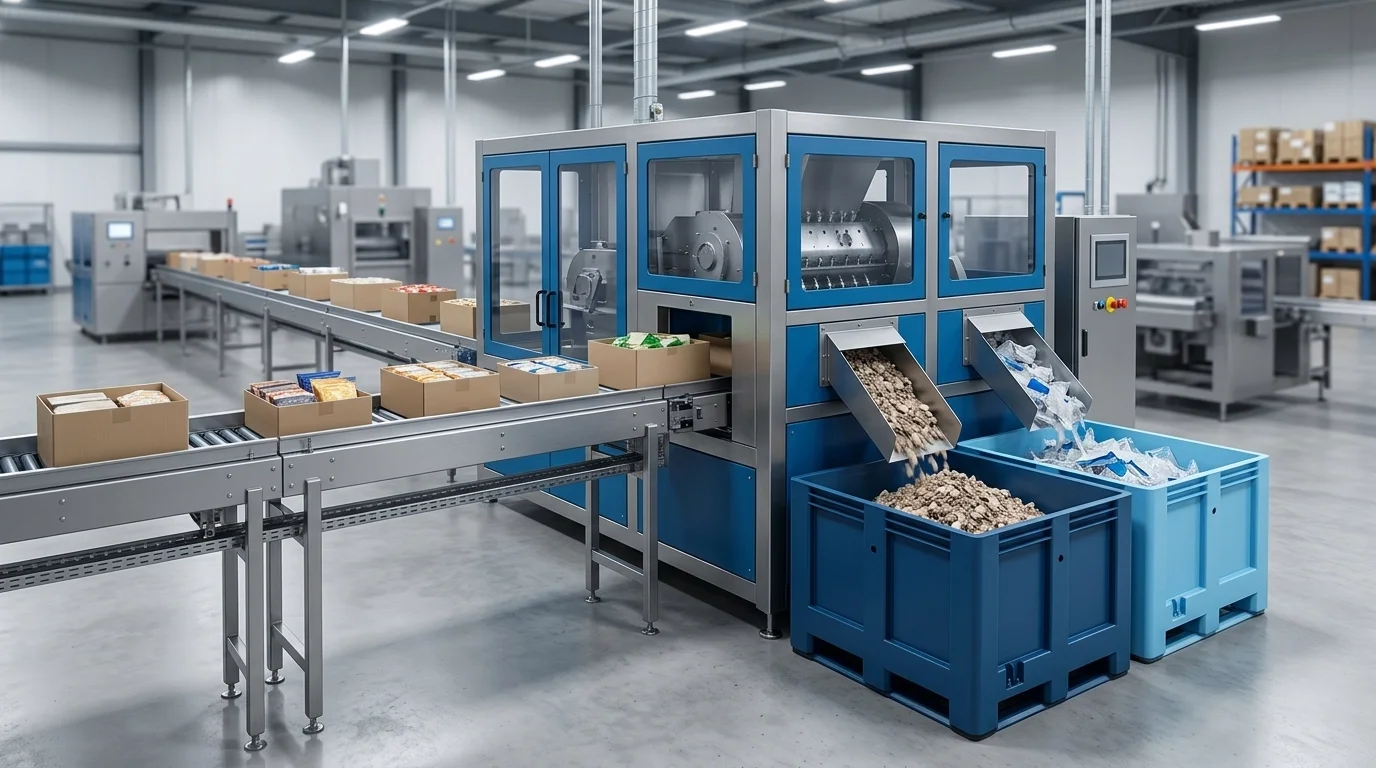
Sending sealed cases of recalled product to a landfill is the shortcut that creates the next headline. Intact retail units can be scavenged, resold, or end up in donation streams. Depackaging separates the food from its packaging at an industrial scale, so that no saleable-looking unit survives.
- Food content is routed to an appropriate outlet such as anaerobic digestion, composting, or animal feed where permitted, or to disposal when contamination rules those out
- Pathogen-related recalls may restrict which outlets are allowed, so the routing needs to match the recall reason
- Packaging is separated and destroyed so that labels, lot codes, and brand marks do not survive
- Allergen recalls may still allow food content to be diverted, because the product is unsafe only for a specific population
Recovered Product Comes From Everywhere
Recall returns arrive from distribution centers, retail backrooms, foodservice operators, and online fulfillment partners, often in mixed condition. Some cases come back sealed, some opened, and some combined with non-recalled product. Every receipt needs to be logged by lot so that it feeds the reconciliation.
Recalled product returned through the ordinary returns stream is a frequent gap. If the returns center does not know about the recall, product can be graded and restocked. Recall instructions need to reach the returns process as well as the warehouse.
Documentation Regulators Expect
- Quantities destroyed by lot code, matched against the recall notice
- The date, location, and facility where destruction took place
- The destruction method and the outlet used for food content
- Records of witnessed destruction where the agency or the company requested it
- A Certificate of Destruction that references the recall by product and lot
Keep the destruction record with the recall file. When the agency reviews whether the recall can be terminated, that is where it will look.
Close the Recall Cleanly
At inventorydestruction.com, food recall projects are handled with lot-level receiving, industrial depackaging, routing matched to the recall reason, and a Certificate of Destruction itemized by lot on every project.
Contact our team today to schedule certified food recall destruction with complete documentation across all 50 states.
