Most companies have a closet, a storage unit, or an offsite vault holding years of backup tapes nobody has looked at in a long time. The systems that wrote them were retired, the backup software changed, and the tapes stayed. They feel harmless because nobody in the building can read them anymore.
That assumption is the problem. A backup tape is not a fragment of data. It is a complete copy of a system at a point in time, often including databases, email, financial records, and customer information, sitting in a cartridge that anyone with the right drive can restore.
Why Tapes Are a Concentrated Risk
A single failed laptop drive exposes one user’s files. A single backup tape can expose an entire file server or database. Tape archives were built to be complete, durable, and portable, which are exactly the qualities that make them dangerous when they leave your control.
Tape drives for older formats are still available, and data recovery firms restore legacy tapes routinely. If your tapes reach a liquidator, an electronics recycler that resells media, or a dumpster, the barrier to recovering what is on them is much lower than most people expect.
Retention Comes First
Before any tape is destroyed, confirm that it is no longer required. Tapes are often the only remaining copy of records subject to retention schedules, regulatory requirements, or a litigation hold. Destroying media covered by a legal hold creates a far bigger problem than storing it.
- Inventory the tapes by label, barcode, and format
- Map each tape set to the system and date range it covers
- Confirm with legal and compliance that no hold or retention obligation applies
- Document the approval to destroy before the tapes leave the building
What NIST Guidance Says
NIST Special Publication 800-88, Guidelines for Media Sanitization, is the reference most organizations use when deciding how to sanitize storage media. It describes three levels of sanitization: clear, purge, and destroy. Revision 2, published in September 2025, moved away from the media-specific tables of the earlier version and focuses on building a sanitization program that matches the method to the sensitivity of the data.
For retired magnetic tape that will never be reused, the practical answer is usually purge or destroy. Overwriting a tape is slow, rarely verifiable at scale, and pointless when the media is leaving service anyway.
Degaussing and Shredding
Degaussing
A degausser applies a strong magnetic field that disrupts the magnetic domains on the tape. Modern high-capacity tape formats have high coercivity, which means they require a degausser rated for that media. A degausser that is not strong enough will leave recoverable data behind. Degaussing also destroys the servo tracks that newer tape formats rely on, so a properly degaussed cartridge cannot be reused.
Physical Destruction
Shredding the cartridge and the tape inside it to a defined particle size eliminates any doubt. Many organizations require both: degauss first, then shred, so that even fragments carry no readable data.
Why Not Just One?
Degaussing without shredding leaves an intact cartridge with your labels on it, and nobody can visually confirm the tape was erased. Shredding without degaussing is effective when the particle size is small enough, but large fragments of tape can still hold readable data. The combination is the standard for sensitive archives.
Chain of Custody Matters More Than the Shredder
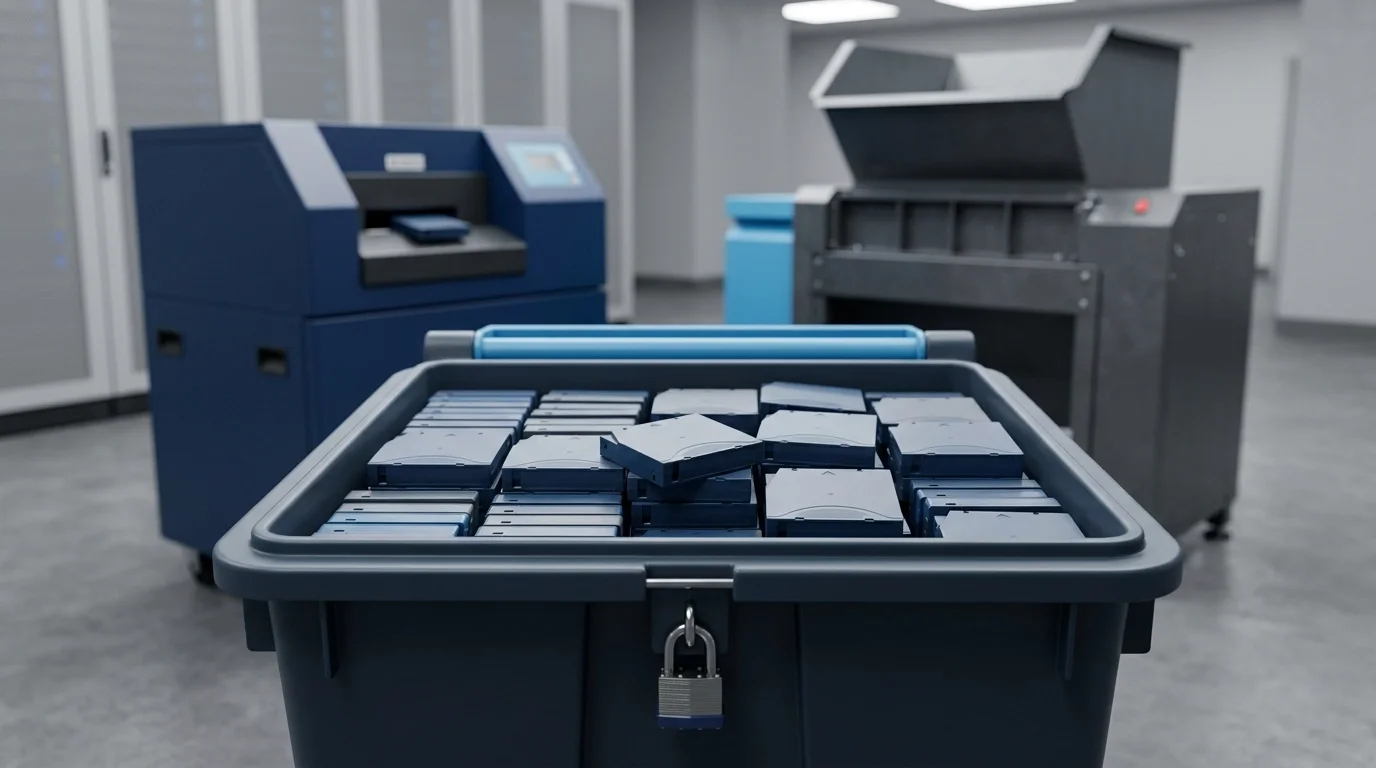
The gap between your vault and the destruction equipment is where control is lost. Tapes should be counted and listed by barcode at pickup, transported in locked containers with recorded seal numbers, and reconciled against the same list at the facility before destruction.
An offsite storage vendor holding your tapes should be part of that chain. Retrieval from the vault, transfer to the destruction provider, and destruction should all be documented under one reconciled list.
Documentation to Retain
The destruction record should list tapes by barcode or serial number, state the method used (degaussing, shredding, or both), name the facility and date, and be signed by an authorized person. Keep it with the retention approval so that the decision and the execution are filed together.
Close Out the Archive
At inventorydestruction.com, backup tape and data media projects are handled with barcode-level inventory at pickup, secure transport, degaussing and shredding as required, and a Certificate of Destruction listing every unit.
Contact our team today to schedule certified backup tape destruction with complete documentation across all 50 states.