When a business retires old hard drives, laptops, smartphones, or servers, there is a dangerous assumption at play: that formatting the device or running a software wipe makes the data safe. It does not. Data recovery techniques can pull sensitive information from drives that have been formatted, reset, or even physically damaged short of full destruction.
For any organization handling customer records, healthcare data, financial information, or proprietary business data, understanding why physical destruction is the only guaranteed method is essential to avoiding a costly data breach.
Why Software Wiping Falls Short
Formatting a drive does not erase data. It simply removes the pointers that tell the operating system where the data is stored. The underlying data remains physically present on the platters or memory chips until it is overwritten, and often it is never fully overwritten. Specialized recovery tools can reconstruct this data with relative ease.
Even dedicated software wiping, which overwrites data multiple times, has limitations. It can fail on drives with bad sectors, it does not reliably address remapped or hidden areas of modern drives, and it provides no physical proof that the data is gone. On solid state drives in particular, wear-leveling and over-provisioning mean that software erasure cannot guarantee every memory cell was addressed.
Why Physical Destruction Is the Only Guarantee
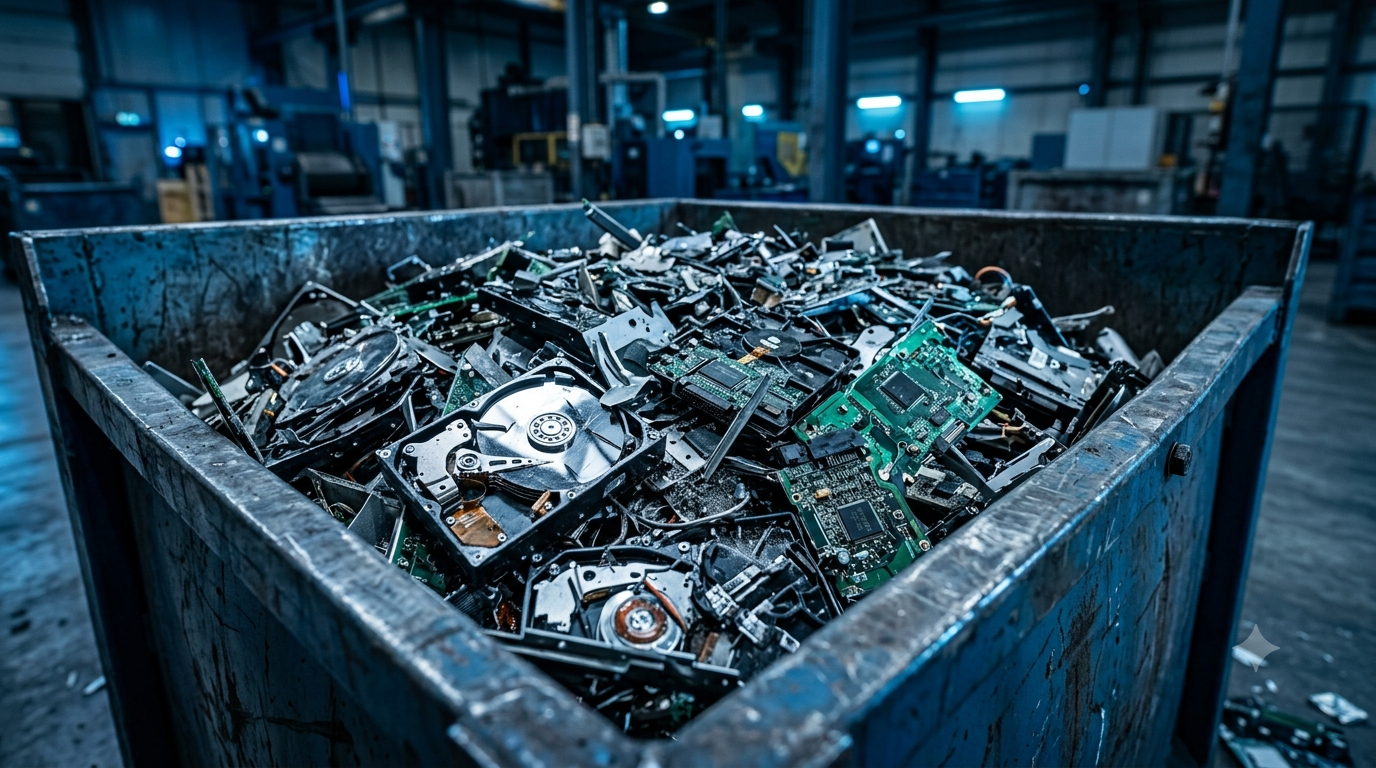
Physical destruction through industrial shredding eliminates the possibility of data recovery by destroying the storage medium itself. When a hard drive is shredded into small fragments, there is no platter left to read and no chip left to interrogate. This is the only method that provides a one hundred percent guarantee of data elimination.
This is why physical destruction is the standard required by the most demanding compliance frameworks, and why organizations in regulated sectors do not rely on wiping alone.
Compliance Frameworks That Require Destruction
Physical destruction of data-bearing devices satisfies the requirements of major data privacy and security regulations:
- HIPAA, governing protected health information in healthcare
- FACTA, governing consumer financial information
- SOX, governing financial records for public companies
- GDPR, governing personal data of individuals in the EU
- PCI-DSS, governing payment card data
- State-level data privacy laws across the United States
For organizations in healthcare, financial services, legal, and government sectors, destruction documentation is not optional. A Certificate of Destruction listing serial numbers, device types, and the destruction method provides the audit-ready proof these frameworks demand.
What Devices Should Be Destroyed
Any device capable of storing data should be considered a data security risk at end-of-life. This includes obvious devices and several that are easy to overlook:
- Computers, laptops, and servers
- Hard drives, solid state drives, and external storage media
- Smartphones, tablets, and mobile devices
- Printers, copiers, and multifunction devices, which often contain internal drives
- Network equipment, routers, and switches
The printer and copier example is instructive. Many organizations destroy their computers but send copiers to resale or recycling without realizing those machines store scanned documents on internal drives. A complete data security program accounts for every data-bearing device.
The Secure Destruction Process
A proper electronics destruction process maintains chain of custody from collection through destruction. Assets are inventoried at collection with serial numbers and device types recorded, transported securely to a certified facility, and physically shredded. Non-data components are then separated and processed according to e-waste regulations, addressing both data security and environmental compliance. A Certificate of Destruction is issued on completion.
Protect Your Data with Certified Electronics Destruction
At inventorydestruction.com, we provide certified electronics destruction with physical shredding of all storage media, satisfying HIPAA, FACTA, SOX, GDPR, and state data privacy requirements. Every project includes a Certificate of Destruction documenting devices by serial number. Contact our team to secure your end-of-life electronics across all 50 states.