
Writing inventory off the books is an accounting entry. Defending that entry two years later is a documentation exercise. Businesses that destroy obsolete, expired, or damaged goods without a proper record often discover the gap at the worst moment, during an audit, an insurance claim, or diligence ahead of a transaction.
This guide covers what evidence the parties who scrutinize write-offs actually look for, and how to build a file that holds up. It is general information rather than tax or legal advice, so confirm specifics with your accountant or counsel.
Why a Journal Entry Is Not Enough
An inventory write-off reduces taxable income and changes the balance sheet. That makes it an area of natural interest to auditors and tax authorities, and the central question is always the same: can you demonstrate that the goods were genuinely removed from commerce rather than sold off the books, diverted, or quietly moved to another channel?
Internal records alone answer that question weakly, because they were produced by the party claiming the deduction. Third-party destruction documentation is stronger evidence precisely because it was produced by someone with no stake in the accounting treatment.
What a Defensible Write-Off File Contains
- The internal authorization that approved the write-off, showing who decided and on what basis
- An itemized schedule of the inventory by SKU, description, lot number, quantity, and carrying value
- The business reason for disposal, whether expiration, obsolescence, damage, recall, or quality failure
- A shipping manifest or bill of lading recording what physically left your facility
- Chain-of-custody records covering the route from your site to the destruction facility
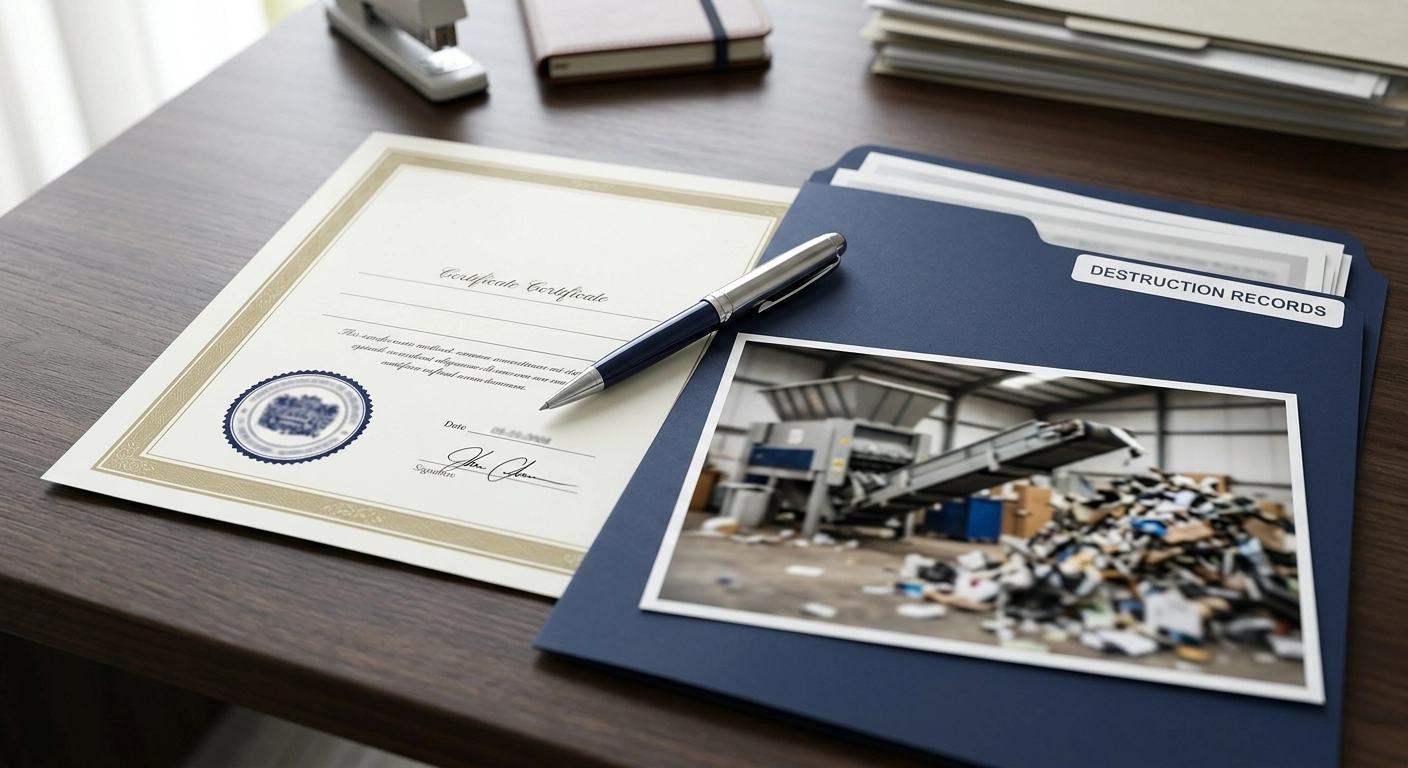
- A third-party Certificate of Destruction identifying the goods, quantity, date, location, method, and facility
- Reconciliation tying the certificate back to the write-off schedule and the general ledger entry
The reconciliation step is the one most often skipped. A certificate that cannot be matched line by line to the accounting entry leaves an auditor doing the matching themselves, and gaps get treated as questions.
What Insurers Look For
Claims involving damaged or contaminated stock follow similar logic. An insurer wants confirmation that the goods were not salvaged, resold, or recovered after the claim was paid, since that would represent double recovery. Certificates that state only that materials were destroyed, without quantities or itemization, routinely slow claims down. Where the loss is significant, ask about witnessed destruction or video documentation before the destruction happens, because it cannot be added afterward.
Duty Drawback on Imported Goods
Businesses that import inventory and later destroy it rather than selling it may be able to recover import duties through the drawback program administered by US Customs and Border Protection. Drawback claims are documentation-driven, with specific notice and evidence requirements around destruction. For importers holding meaningful quantities of unsellable stock, this can turn a disposal cost into a partial recovery, but only if the destruction is documented to the required standard rather than reconstructed after the fact.
Timing and Retention
Two practical points cause most of the trouble. First, documentation has to be created at the time of destruction. Nothing produced afterward carries the same weight, and a certificate cannot be back-dated to an event that was never recorded. Second, retention periods for tax records commonly extend for years, and destruction documentation should be retained on the same schedule as the return it supports rather than filed with operational paperwork that gets cleared out annually.
Build the Documentation Into the Project
At inventorydestruction.com, every project produces itemized, audit-ready documentation, including chain-of-custody records and a Certificate of Destruction issued as a standard deliverable regardless of project size.
Contact our team today to schedule certified inventory destruction with complete write-off documentation across all 50 states.